When the Market Disagrees: The I’ll Be Back Dilemma at Hamilton Hamilton 3.25 — Class 2 Handicap, 1m 68yds

One of the most difficult decisions for any punter comes when the form, the ratings and the price all point towards a bet—but the market appears to be shouting a warning.
That is precisely the situation I am facing with I’ll Be Back in today’s 3.25 at Hamilton.
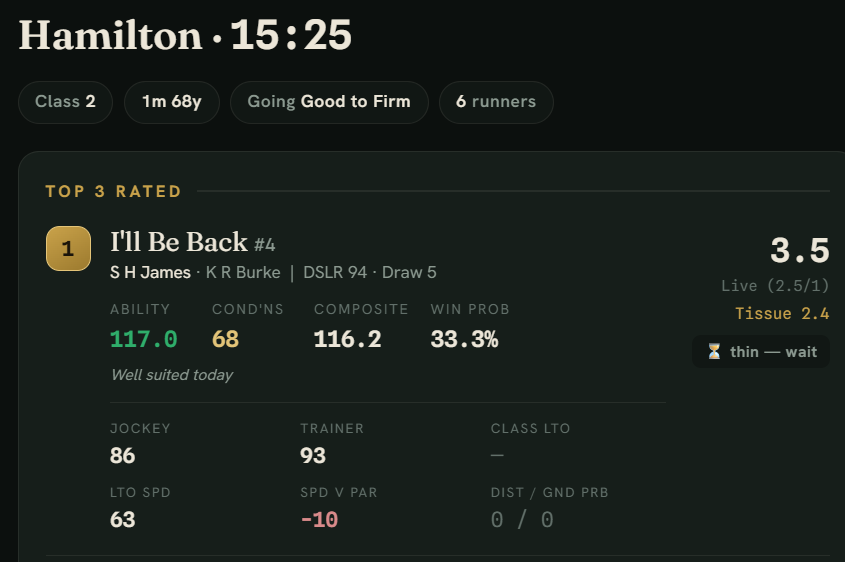
On my dashboard, the Karl Burke-trained colt is clearly the top-rated runner. He has the strongest ability figure in the field, scores well for today’s conditions and sits comfortably clear on the composite ratings. My tissue price has him considerably shorter than his current exchange odds, so purely from a value perspective he looks like an obvious bet.
Indeed, when I first assessed the race, I marked him down as a maximum five-point selection.
However, there are two significant uncertainties: his absence from the racecourse and the increasingly uncomfortable market movement.
Solid Form Beneath the Surface
I’ll Be Back has not raced since winning a Class 4 novice at Leicester on 13 April, but that performance appears considerably stronger than it may have looked at the time.
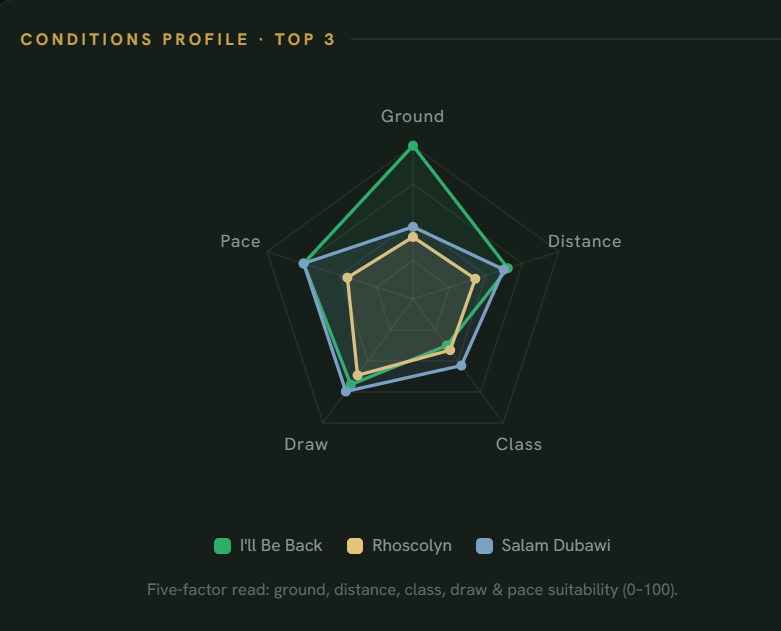
He was still inexperienced that day. He wandered around and showed signs of greenness when asked to settle the race, but he nevertheless won readily. Having watched the race several times, my view is that the official margin did not do justice to his superiority. I would estimate that he was value for something approaching four lengths over the runner-up, King’s Cavalry.
That is important because King’s Cavalry, a well-bred Kingman colt, subsequently won his next two races. The Leicester contest has developed into a hot little novice, with several horses coming out of it and winning.
The form therefore looks solid, and I’ll Be Back remains open to considerably more improvement than we have seen on the racecourse so far. On ability and potential, he is entitled to be competing in a Class 2 handicap.
The 93-Day Absence
The obvious concern is his 93-day absence.
I’ll Be Back was declared to run on 4 July and was priced at around 10/11 favourite, but he was withdrawn. The reason may have been connected to the ground, although without knowing exactly why he did not run, some uncertainty remains.
A break of 93 days is not automatically a negative, particularly for a horse trained by Karl Burke. It is also encouraging that the stable was preparing to run him less than two weeks ago. Nevertheless, when dealing with a lightly raced and still inexperienced horse, race fitness cannot simply be taken for granted.
This is the one area in which the dashboard cannot provide a definitive answer. The ratings can tell us what the horse is capable of producing under today’s conditions; they cannot tell us with certainty whether he is fully ready to produce it after three months away.
A Market Sending Conflicting Signals
The early market has made the decision considerably more difficult.
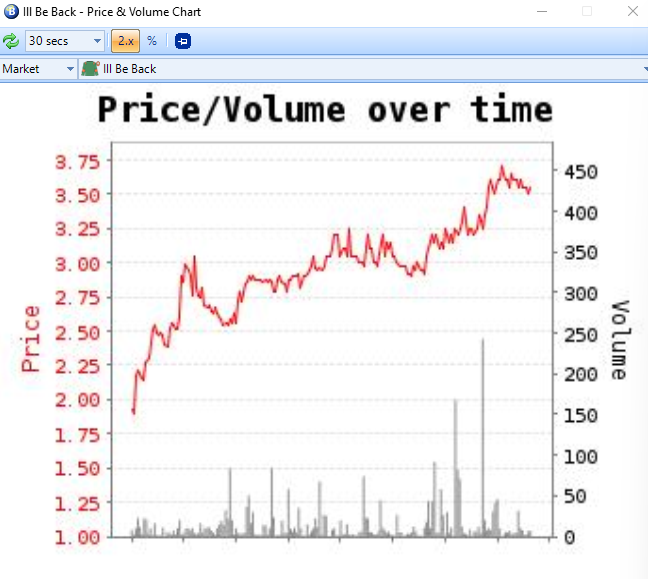
I’ll Be Back reportedly opened at a shade of odds-on but has drifted steadily and is now trading at approximately 3.5 to 3.7. That is not a minor adjustment. It is a substantial change in the market’s assessment of his chance.
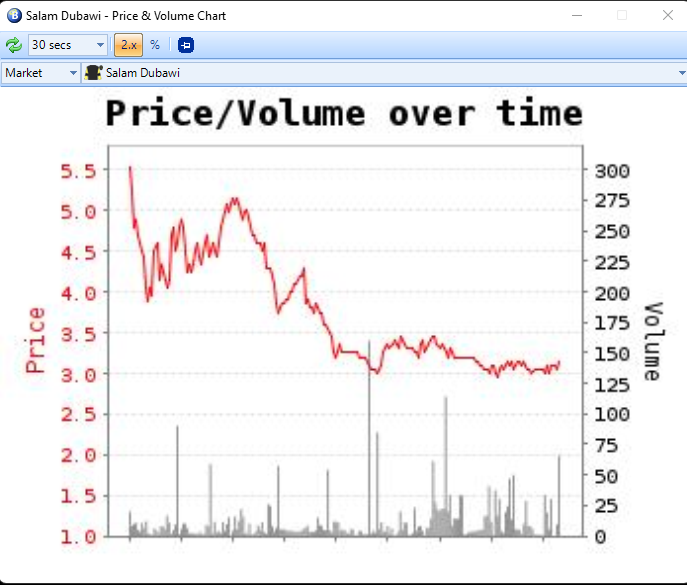
At the same time, Salam Dubawi has attracted strong support, shortening from around 5.5 to 3.1.
The contrasting price charts are striking. I’ll Be Back has moved persistently outwards, while Salam Dubawi has shortened sharply before stabilising close to the head of the market.
Ordinarily, such a pronounced drift would demand respect. However, liquidity remains relatively low at the time of writing. Early exchange markets can be distorted by modest amounts of money, particularly in a six-runner race. A move from odds-on to 3.7 looks dramatic, but its significance depends heavily upon how much money has actually been traded.
That is why blindly following the market can be almost as dangerous as ignoring it completely.
Three Possible Decisions
The first option is to abandon the bet. The market is raising a clear question over the horse, and the 93-day absence provides a plausible explanation for the weakness. Turning the race into a no-bet would remove the risk of opposing potentially informed money.
The second option is to trust the ratings and accept the bigger price. If my assessment of the Leicester form is correct, odds of around 3.7 may represent considerably better value than was available earlier.
The third option is to wait.
That is the route I am taking.
At present, I do not believe the liquidity is strong enough to justify completely reversing my original opinion. Equally, I would not now be comfortable placing the full five-point maximum stake without seeing how the market develops closer to the off.
As more money arrives, the market should become more informative. Should I’ll Be Back stabilise or begin to shorten, it would suggest that the earlier drift was caused by weak liquidity rather than a serious lack of confidence. Should he continue to weaken once meaningful money enters the market, the warning would become much harder to dismiss.
The Disciplined Decision
My current view is that I’ll Be Back remains the most likely winner on the form, but the combination of his absence, the unexplained withdrawal and the market weakness means he no longer qualifies as a maximum-stake bet.
The mistake would be to “sit and suffer” simply because five points had already been written beside his name. A staking decision should never become emotionally fixed before the market has fully formed.
Were the race taking place immediately, I would reduce the proposed stake rather than either abandoning the horse completely or pressing ahead with the original maximum bet. The larger price provides additional value, but the uncertainty also increases the risk.
For now, the correct approach is patience.
Monitor the liquidity. Watch whether the drift continues when the serious money arrives. Remain prepared to reduce the stake—or make the race a no-bet altogether—if the market weakness becomes more convincing.
The ratings have made the case for I’ll Be Back.
The market is asking whether today is the day he will show it.
That is the dilemma, and sometimes the most disciplined betting decision is not made when the market opens, but in the final few minutes before the stalls do.